
War Chest
On Memoir, Risk, and What It Costs to Be Seen

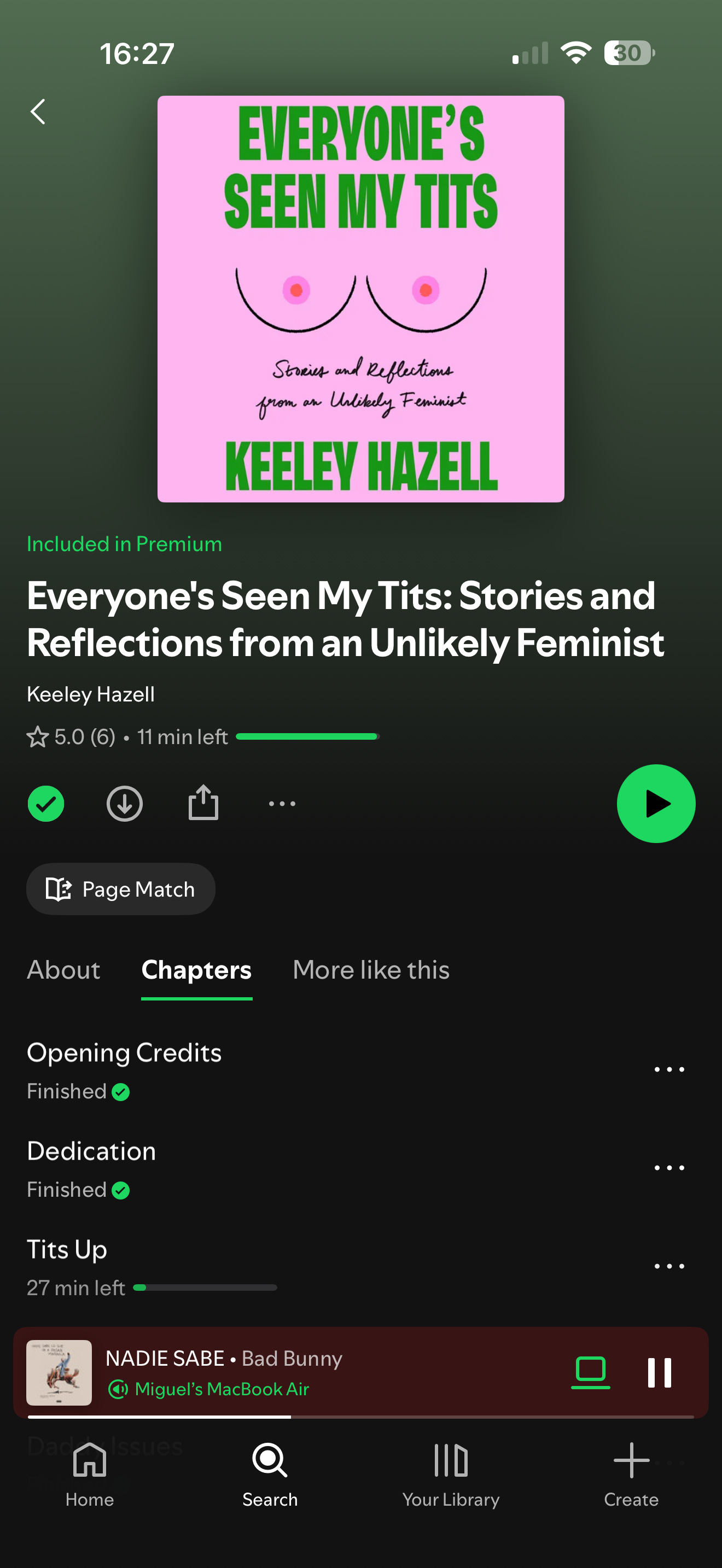
I just finished Everyone’s Seen My Tits by Keeley Hazell with complicated admiration, which, for me, is usually a sign a memoir is doing some real work.
I should say first that I didn’t read this book traditionally. I listened to it. I heard it in my Mustang, where most of the magic happens, and through my AirPods while lifting weights on the gym floor. Lately, listening has become my favorite way to take writing in. I can’t fully explain it, but the language seems to last longer in my body. It settles differently. My ideas stay more malleable. Sentences linger in the muscles, not just the mind. I find myself wanting to elaborate more carefully afterward, to shape my own voice with more intention.
That felt especially true with this book.
This is not a memoir asking to be forgiven, and it’s not asking to be rescued from its own title. Hazell understands exactly how her body has been consumed by the public, and how often that consumption has been mistaken for intimacy, empowerment, or choice. What surprised me is how little the book leans on grievance. Instead, it keeps circling a harder and more enduring question: what does it cost to be seen everywhere and still feel fundamentally unseen?
The writing is uneven in places, and honestly, I like that. Life isn’t a straight line. Some chapters move with real clarity and reflection; others feel closer to notes spoken aloud in the dark and left mostly intact. Hearing those moments rather than seeing them on the page changed the experience. The voice carries hesitation, conviction, and fatigue. The book isn’t trying to act polished so much as track survival as it happens. That unevenness feels intentional, even necessary, as if smoothing it out would have meant lying about the process. There’s a refusal here to make everything make sense retroactively, and I respected that restraint.
What stayed with me most was the class awareness threaded through the book. This is not a celebrity memoir pretending the machine doesn’t exist. Hazell is attentive to how class, gender, and proximity to power shape who gets protected and who gets consumed. The feminism here is not academic or declarative. It’s lived, partial, and sometimes conflicted, which makes it believable when heard aloud. We aren’t meant to understand everything all at once as we move through it, and the book doesn’t pretend otherwise.
I know there will be people who dismiss this outright. People who say it’s just a celebrity memoir, or that she isn’t a real writer. I’ve heard versions of that my whole life. Those comments almost always come from people who have never tried to put their life on the page, or online, or into a room full of strangers. Writing a memoir takes a particular kind of bravery. It’s closer to stepping into a ring than most people want to admit. You’re exposed. There’s nowhere to hide. The bell rings, and whatever you brought with you is all you have. People love to analyze fighters from the outside, love to talk about technique and toughness, but they’ve never stood there themselves, never felt what three minutes really costs. Writing is like that. You don’t get credit for talking about the fight. You earn it by stepping in and taking the hits.
That’s why what drew me to this book wasn’t fame or image, but risk. The willingness to stay in the work even when it’s uncomfortable, even when the story refuses to flatten itself into something neat or reassuring. The book doesn’t try to make the narrator likable at every turn. It doesn’t rush to explain itself. It asks the reader to stay present, to sit inside the conditions that shaped the voice, and to tolerate the unease that comes with that kind of honesty.
This is far from a perfect book. It made me laugh at times, but it isn’t a comedy. Some moments feel genuinely tragic, but it isn’t a book that asks for tears. What it offers instead is sincerity. A willingness to stay with experience as it is, without forcing it into a single tone or lesson. The book doesn’t rush toward redemption or clarity. It allows contradiction to exist. That kind of truth, especially when paired with self-interrogation rather than self-justification, still counts for something. It creates space for a reader to think, to feel, and to remain unsettled in a way that feels honest.
There’s something else I haven’t said yet. Hearing Hazell tell this story in her own voice, not just reading the words but hearing the performance, was extraordinary. There’s an old idea that if you don’t write your own story, someone else will write it for you. I think the same is true for telling it. If you don’t speak it, perform it, embody it, someone else will decide the tone, the meaning, and the limits.
Listening to her narrate this book felt like watching someone reclaim authorship in real time. She wasn’t just reading; she was acting the story, shaping it breath by breath. And it did something unexpected to me. It made me want to tell my own story out loud. Not just write it, but say it. Yell it. Perform it. It even made me want to act, which is strange to admit, because I’m not an actor. Or at least I don’t think I am.
I was watching a documentary about Mel Brooks not long ago, and someone asked him why he does what he does. He said he does it because he wants love, love from people. When they asked him if the love from his family was enough, he said something like, I don’t want that love. And I understood exactly what he meant. That love is sacred. It’s given. But the love that comes from making something, from standing in front of strangers and offering your voice, your work, your risk, that’s a different kind of love. It has to be earned. It has to be risked.
That’s why I write. That’s the love I want. And listening to Hazell tell her story made that desire louder in me. It reminded me that art isn’t just confession or craft. It’s performance. It’s courage. It’s asking to be heard on your own terms, without apology.
She did that here. Congrats, Keeley Hazell. I can’t wait to hear what you have to say next. Writing is like fighting. You don’t stop because one round went well. You breathe, you reset, and you go back out. You take what you learned, what hurt, what surprised you, and you let it sharpen you. Another round is waiting. And if this book is any indication, you’re ready to answer the bell again.
Miguel A. Castillo Jr. is a writer, boxing and strength coach, and former U.S. Marine and NYPD officer based in New York City. A former Golden Gloves boxer with over 40 amateur fights, he earned the silver medal twice as a heavyweight. His work explores masculinity, violence, class, and authorship through lived experience, often drawing connections between writing, performance, and physical training. He is the author of the memoir-in-progress The Rogue’s Gallery, a graduate of New York University’s MFA Creative Writing Program, and is currently completing a second MFA in Screenwriting at Manhattanville University. He loves pain.
This just made me smile because I am writing a memoir and don't want to be loved but want people to see the strength, just like you said the author did. "need to be seen", love that.
Thank you for sharing this. This came at the perfect time!