
Arrival
A Short Timer's Guide to Surviving Prison

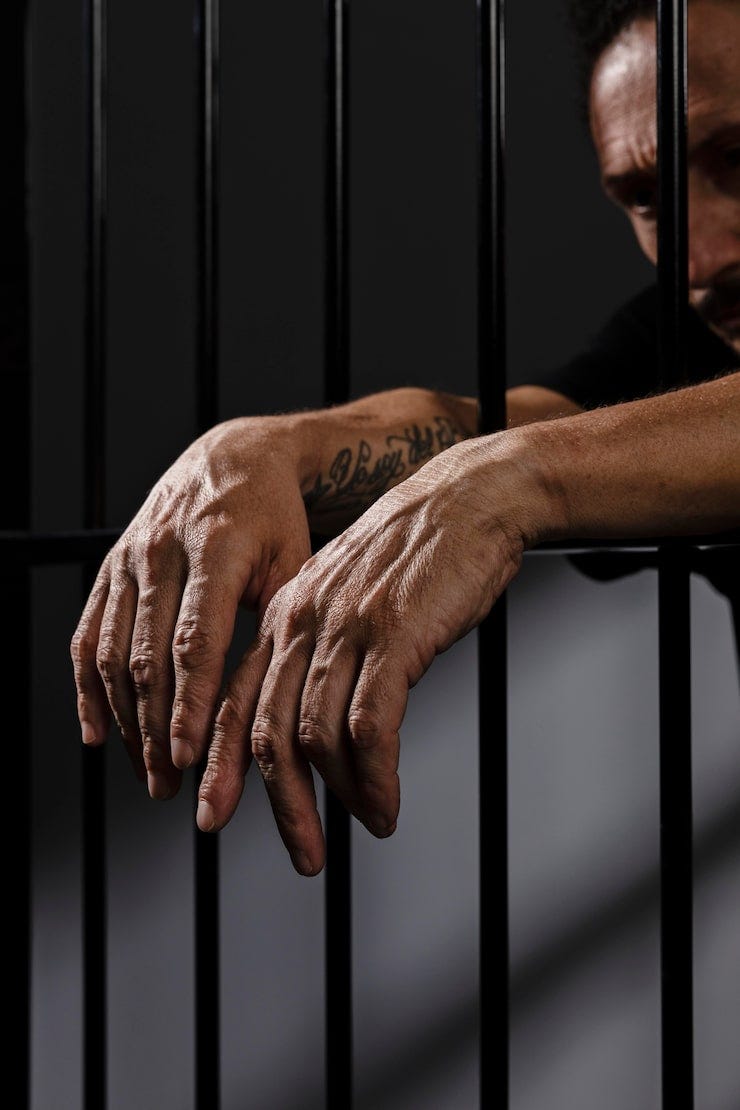
First, you get there. The bus doors fold open with a tired sigh. The air smells like dirt and old sweat. Chains shift. A gate groans somewhere ahead of you. You step down carrying everything you’re allowed to own in one small bag, and already it feels like too much.
When you get to the main building, don’t act like no punk bitch. But don’t act like the baddest motherfucker on the yard either. Both will get you hurt. You have to act like you’ve seen it all, even if you haven’t, especially if you haven’t. Prison reads posture before it hears words. Your shoulders will tell on you faster than your mouth ever could.
When you stand in front of the warden, don’t call him sir. He works for a living. This isn’t the Marines anymore. Standing tall in front of a commanding officer was about discipline and hierarchy. It was about making you something better than what you were. There was a ladder there. There was a belief, however flawed, that if you endured enough, you rose.
Standing in front of the warden is about processing. It’s about money. To him, you’re just a number. A bed filled. A file moved. A body counted at zero six and twenty hundred hours. He isn’t there to test your honor. He’s there to keep the machine moving. The faster you understand that, the less personal it feels.
Don’t offer him pride. Don’t offer him defiance. Offer him nothing he can use. Answer what is asked. Keep your voice level. Keep your hands still. You’re not there to impress him. You’re there to pass through.
He doesn’t need your respect, he only needs your paperwork complete. Let him do his job. Let yourself move to the next room.
When you get to your unit and see a Nazi, a Blood, and a Crip playing chess at the same table, don’t stare. Don’t ask questions. Don’t try to understand it. Prison has its own logic, its own rules, and it doesn’t owe you an explanation. Curiosity reads as weakness. Judgment reads as a threat. Keep walking.
When your bunkmate offers you food, don’t take it. Food creates debt. Debt creates leverage, and leverage creates problems. There are exceptions, but you won’t get many. If your bunkmate is six foot nine, a former NBA player who accidentally killed his chauffeur, and looks like he could lift you with one hand and apologize while doing it, then you take the food. Tuna fish and Jack Mack. Top Ramen. You say thank you. You understand the difference between generosity and danger.
And when he asks you what size shoes you are, tell him the truth. Say size thirteen. When he tells you that’s two sizes too small, say sorry. Manners go a long way. Prison recalibrates everything. It stretches time. It contracts space. It changes bodies. What fits you on the outside won’t fit you on the inside.
When someone asks you what you’re in for, also tell the truth. Prison has a better lie detector than the streets. Hesitation reads as guilt. Embellishment reads as insecurity. Performance reads as fear. You tell them you’re a crooked cop, and you’ll get distance. Maybe a little respect. At least a place on the map. The air will shift for a second. Someone will nod. Someone will look away. The label will settle over you, and you will learn how to finally stand inside it without flinching.
If you’re a child molester or a rapist, you say nothing. Or you lie. And if you can’t lie, you keep your mouth shut and your head down. Criminals have a code. It isn’t noble, and it isn’t clean, but it is real, and it will kill you if you violate it. Respect the totem poles.
Keep your nose clean. Not because you’re scared, but because chaos compounds. Trouble multiplies. One small incident brings friends, friends bring weapons, and weapons bring more time. More time brings death.
Pay attention to the small things. Don’t snore. Correct it. This isn’t optional. Don’t fart loudly. Own it immediately. When you take a shit, courtesy flush before and after. Wash your feet. Wash yourself. Don’t be funky. Hygiene is respect in a place where privacy doesn’t exist. Smell is an offense. Comfort is currency. Also, don’t steal from the men next to you.
Remember, prison isn’t about toughness. It’s about adjustment. It’s about knowing when to shrink and when to stand, about learning the cost of every move before you make it. You learn how to wait without looking desperate. You learn how to listen without appearing interested. You ear-hustle. You learn how to disappear without becoming invisible. You learn that those things are not the same.
There are things you don’t talk about. You don’t tell people how much time you have left. You don’t tell them how close you are to going home. Don’t let them call you Short Timer. Time is leverage in prison, and hope is a liability. Men measure you by what you’re carrying, and if they know you’re lightening your load, they’ll test how much more you can afford to lose. Your release date stays unspoken.
You will wait constantly. You will wait in lines, for count, for meals, for mail. You will wait for your family back home. You don’t talk about that either, not in detail, not early on. You don’t give people pictures, physically or mentally, of what can be taken from you. Love is real, but in here it’s also information. At night, when the lights die, and the tier finally goes quiet, you will replay ordinary scenes in your head. A kitchen table. A laugh you can almost hear. The way a door sounds when it closes softly instead of slamming. You won’t let your face change while you think about it. You will stare at the ceiling and breathe evenly. Waiting is something you practice, even in the dark.
You learn to hold your future quietly. You learn to carry it the way you carry contraband, close to the body, never displayed. You learn to sit on your bunk and look like a man with nowhere to be, even when every part of you is rehearsing the walk out.
Prison can wait forever. It will wait for you to slip. It will wait for you to brag. It will wait for you to believe the worst is over. So you keep your routines routine, your mouth shut, and your head down.
And you remember this. Prison is designed to convince you that this is who you are now, that this is permanent, that the outside is a story you made up to survive the night. Don’t help it do that.
You are not your number. You are not your bunk. You are not the worst thing you ever did. You are a man waiting, and waiting in here is an active skill. It means planning without revealing the plan, counting time without announcing that you’re counting, and learning how to survive days that look identical without letting them erase you. You rehearse your future quietly. Ordinary things. Car keys in your hand. A door opening. You don’t say any of it out loud. Hope survives best when no one else can touch it.
Man, I’ve been home for more than fifteen years now, and I still recognize that skill when it shows up in my life. Prison taught me how to manipulate time, how to stay put without giving up, how to let things unfold instead of forcing them. I never thought it would play out like this. Back then, lying on that bunk, staring at chipped paint and listening to men cough in their sleep, I kept my dreams small on purpose. A job. A quiet kitchen table with a beer and a bacon cheeseburger, fries. I didn’t dare imagine much more than that.
I’ve accomplished more than I ever let myself picture up there. Built a family. Built work with my own hands. Built mornings that begin without count. The discipline of waiting turned into patience, into steadiness, into the long work of becoming someone better than I was. I thought survival was the goal. Turns out it was training. That skill followed me home.
About the Author:
Miguel A. Castillo Jr. is a writer, retired U.S. Marine, former NYPD officer, and boxing coach based in New York. He holds an MFA in Creative Writing from NYU, where he was a Goldwater Fellow, and is currently completing a second MFA in Screenwriting at Manhattanville University. His work explores masculinity, incarceration, moral injury, and American systems of power from the inside. He is the author of the memoir The Rogue’s Gallery and lives in New York with his family. If you feel inclined, support his work at https://buymeacoffee.com/miguelcastillospeaks.
This is a story I wish you didn't have to tell, but you've told it well.
Loved so many things about this post. Can’t wait to talk it out with you on Thursday!